

Filters
43 focus found

How much Mar Piccolo peculiarities are due to groundwater outflow
The Mar Piccolo basin is an internal sea basin located along the Ionian coast (Southern Italy), and it is surrounded primarily by fractured carbonate karstic environment. In primarily karstic environments,...

How we map landslides
A landslide is the movement of a mass of rock, debris or earth along a slope under the influence of gravity. Landslides pose serious threats in many areas of the...
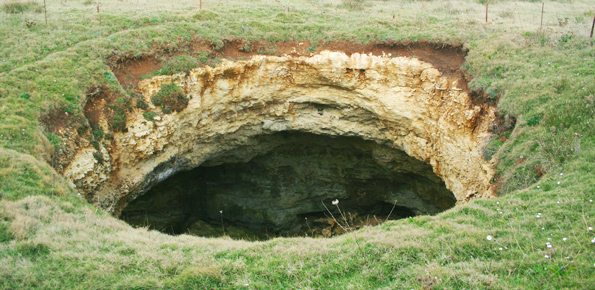
Chronological database of sinkholes in Italy
Sinkholes occurrence is related to the presence of an underground cavity, from which instability starts and propagate upwards until causing the collapse of the surface soil layer. The cavity may...

Active alluvial fans in Calabria, Southern Italy
Alluvial fans are known to be areas of high geomorphic activity, where debris flows and flash floods caused by intense and prolonged rainfall are a major hazard. In Calabria, southern...
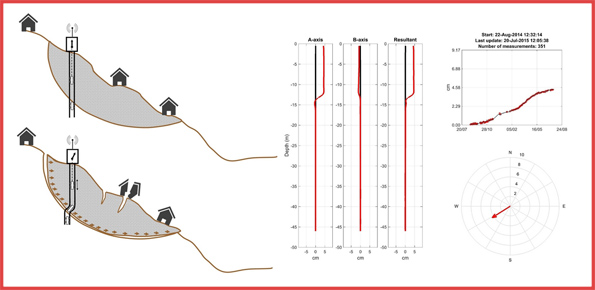
Automated Inclinometer System (AIS) for deep-seated ground deformation measurements
Our AIS (Automated Inclinometer System) allows for fully automatic inclinometer measurements in standard boreholes. The deep measurements have multiple applications, including (i) evaluating the rate of deep-seated ground deformation in...

What is the origin of the large Isidis Planitia, on Mars?
The characterization of an impact crater requires an understanding of the impact phenomena, considering the properties of the materials involved in the impact. The size and energy of the projectile...
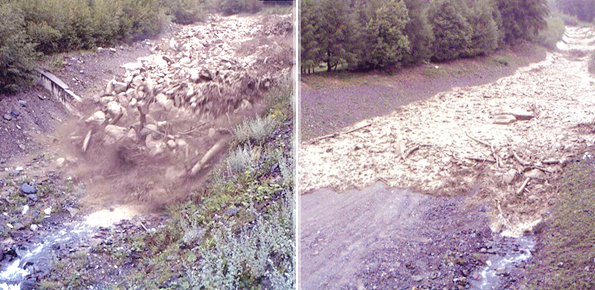
Debris-flow monitoring in the Alps
Not all that flows in creeks is water. Debris flows i.e., surges in which solid particles move together with little water, may occur in steep mountain streams, mainly as a...
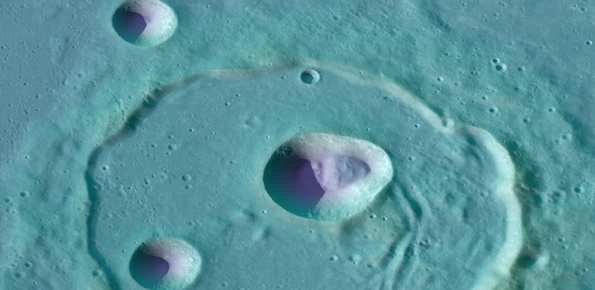
Landslides in the Solar System
On Earth, landslides are hazardous phenomena often associated with economic damage and loss of human lives. The most common natural triggers of terrestrial landslides are intense or prolonged rainfall, earthquakes,...
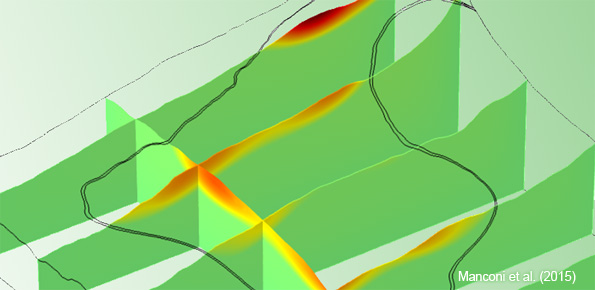
Kinematics of slow-moving active landslides
We experiment the application of 3D numerical modelling techniques for the analysis of the kinematics of slow-moving active landslides. The activity assesses the hazards posed by slow-moving landslides, determines the...
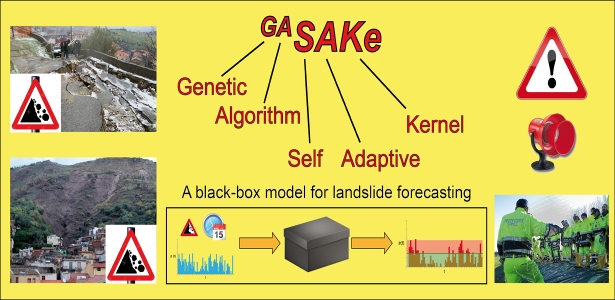
Forecasting rainfall-induced landslides
We developed GASAKe, Genetic Algorithm-based Self-Adaptive Kernel, a new model to predict the time of occurrence of rainfall induced landslides. GASAKe predicts the time of occurrence of single landslides or...

Geomorphometric analyses in mountain catchments
Geomorphometry complements the traditional qualitative description of landforms with a quantitative approach based on the analysis of Digital Terrain Models, which are numerical representations of the topography. For the purpose,...

Earthquake-induced landslides
Landslides and earthquakes are important geological hazards in Italy, where mountains and hills dominate a landscape characterized by the presence of weak geological materials. The geological and morphological settings result...
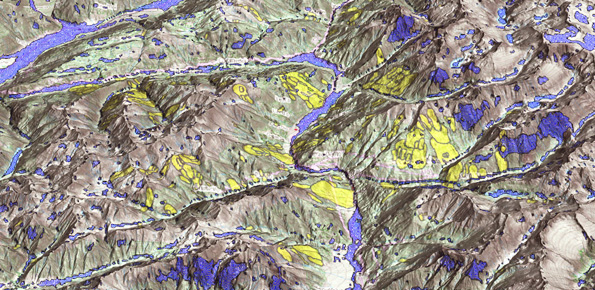
Where we should not expect landslides?
Landslide susceptibility is the propensity of a territory to generate landslides. Many methods are available to determine landslide susceptibility, whereas only a few attempts were made to outline areas not...

The strong retreat of the Italian glaciers
Between the late 19th and early 21st century, in the Alps the average air temperature has increased by about 2 °C, more than twice the increase in temperature in the...

ALMOND-F, an ALarm and MONitoring system for Debris-Flows
ALMOND-F is an innovative unit for the microseismic detection of debris flows using a network of geophones. The microseismic detection of debris flows is more complex than other types of...