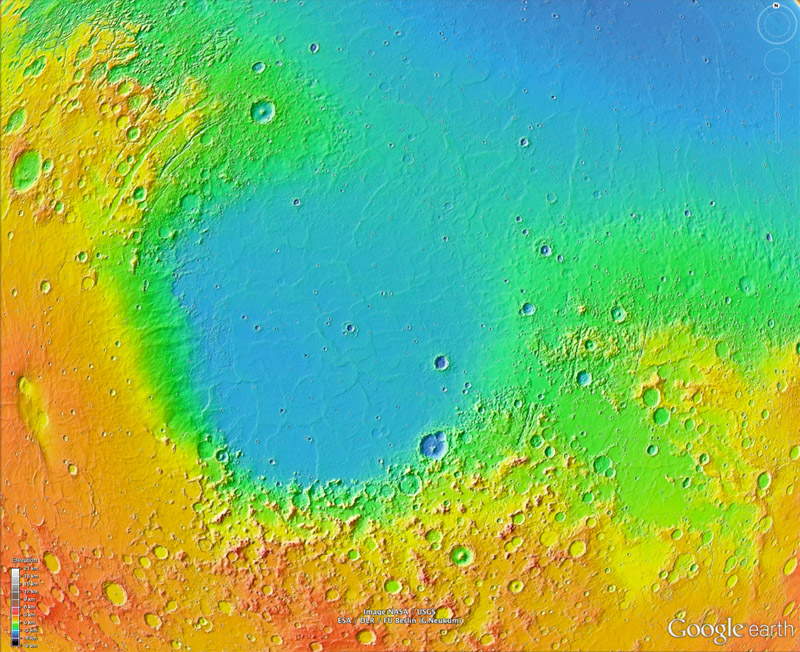
What is the origin of the large Isidis Planitia, on Mars?
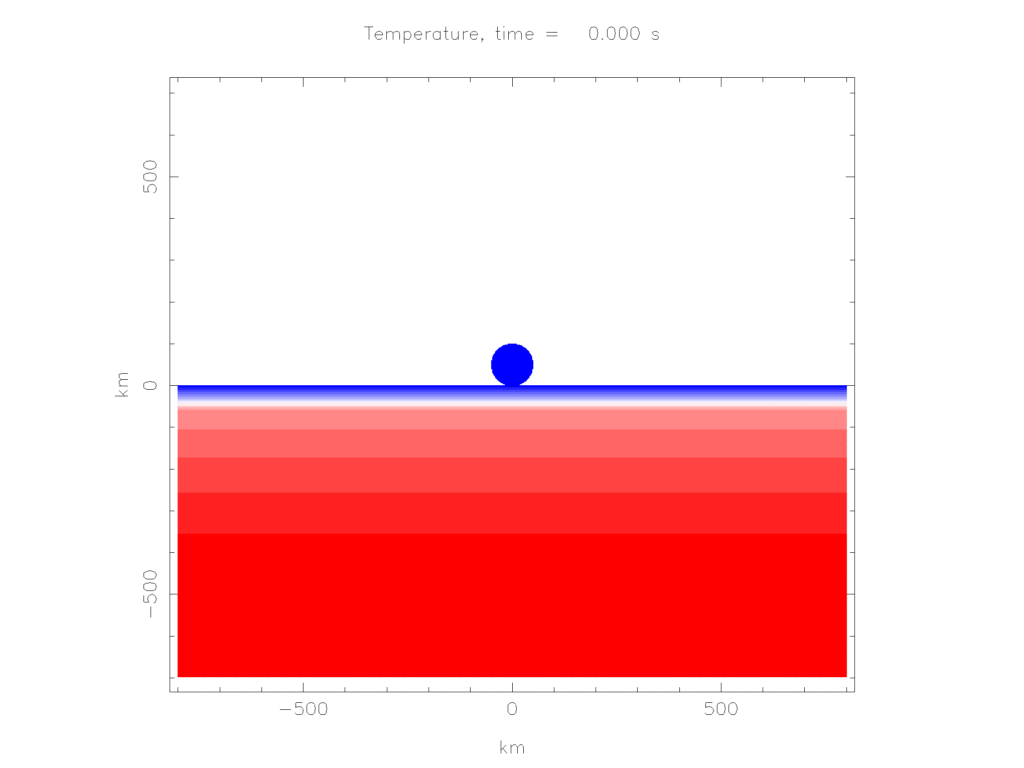
We modelled a 4-billion years old impact caused by of a 50-km large projectile that formed the large Isidis Planitia basin, on Mars
Focus
Involved offices:Perugia
The characterization of an impact crater requires an understanding of the impact phenomena, considering the properties of the materials involved in the impact. The size and energy of the projectile control the width and depth of the crater. Related to impact craters is the formation of mass concentrations, or mascons, which produce intense positive gravity anomalies. One of the largest mascons is in the Isidis Planitia, Mars.
Using the finite element code iSALE hydrocode, we modelled the impact event that originated the Isidis basin, on Mars. We studied the evolution of the materials shocked and melted by the impact. We obtained the lithospheric structure, an input for our model, through a bottom-load flexure model constrained to fit the calculated admittance, which we estimated from gravity and topography remotely sensed data in the spectral domain.
The flexural models allow retrieving the elastic and crustal thickness, the thermal gradient, and the heat flux under the assumption that (i) the observed gravity signature that represents the mascon is related to the impact event, and its following evolution, and (ii) the achievement of the present state was influenced by the thermal and the flexural evolution of the lithosphere.
We obtained our best-fit admittance model with a 10 km thick, thin crust formed likely by cooling of the superficial melt pool after the impact, and an elastic thickness of 36 km.
Mancinelli P, Mondini AC, Pauselli C, Federico C. 2015. Impact and admittance modeling of the Isidis Planitia, Mars. Planetary and Space Science. DOI: 10.1016/j.pss.2015.04.019.
Home » Focus » What is the origin of the large Isidis Planitia, on Mars?