We monitor the Planpincieux Glacier, along the Italian side of the Grandes Jorasses, Aosta Valley
We use a high-resolution optical-based system to study the evolution of the Planpincieux glacier located on the eastern slope of the Grandes Jorasses, in the Mont Blanc massif.
Focus

Internal contact person: Daniele Giordan
Email: daniele.giordan@cnr.it

Glaciers are typical of the Alpine landscape, and an important source of water. Undoubtedly fascinating, glaciers are very complex and yet surprisingly poorly known. In the Alps, many studies focus on the volumetric changes of glaciers, proving their almost systematic reduction in the current climatic period. Little is known about the daily behaviour of Alpine glaciers. This is partly due to the inhospitable and not easily accessible environment of the Alpine glaciers, that complicates their investigation.
The lower (terminal) part of an Alpine glacier can be very active, and characterized by the presence of crevasses and seracs, and collapse phenomena that make these areas difficult to access and very dangerous. The difficulty of access is greater if the glacier front is suspended, or placed along a steep slope.
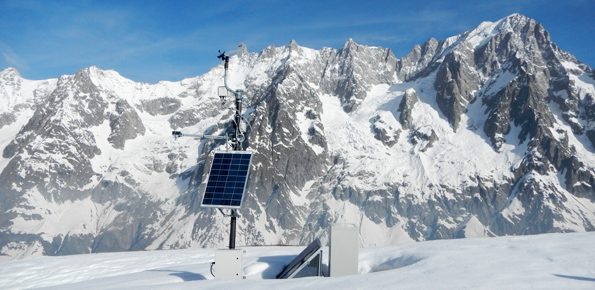
To better understand the evolution of the front of an Alpine glacier, in collaboration with Fondazione Montagna Sicura, we designed and developed an experimental station to monitor the Planpincieux glacier, in the Grandes Jorasses, on the Italian side of the Mont Blanc massif.
Planpincieux is a hanging glacier, with the front placed at a steep break in slope. The location, the very steep morphology of the front, and frequent local instabilities, make it impractical to install monitoring systems and tools on the front of the glacier. For this reason, before our project the information available on the rate of movement and the dynamics of the Planpincieux glacier was limited, fragmented and qualitative.
Video 1: Evolution of the Planpincieux Glacier in the Summer of 2015.
We designed and deployed a low-cost monitoring station capable of operating throughout the year at more than 2000 meters of elevation and in difficult climatic conditions. The monitoring station measures the movement of the front of the Planpincieux glacier, allowing for a better understanding of the processes governing the evolution of the glacier.
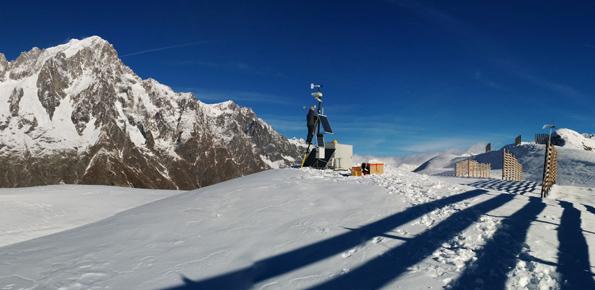
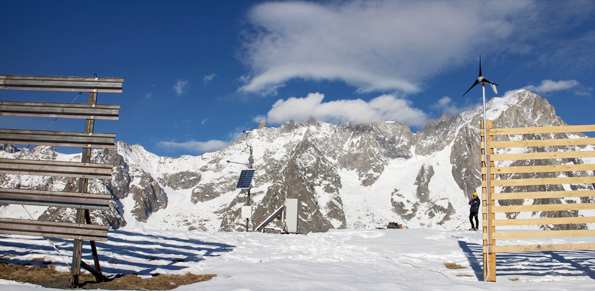
In September of 2013 we installed the monitoring station on the summit of Mont de La Saxe, facing the glacier at a distance of over 3.5 km from the Planpincieux glacier. The station consists of a meteorological station, a camera with zoon capability for the acquisition of optical images, and a second camera for the acquisition of high resolution optical images.
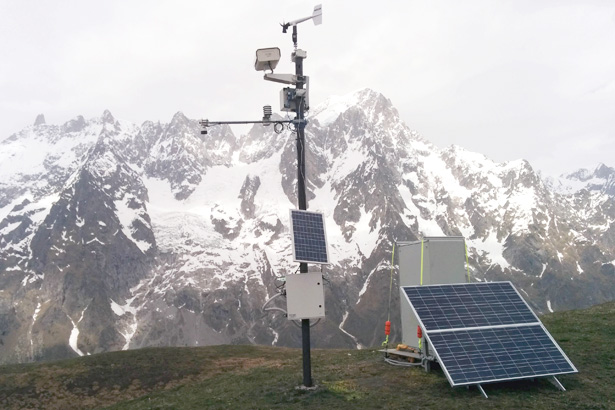
Figure 1: The monitoring station; in the background the Grandes Jorasses.
The monitoring station is powered by solar panels, and connected via UMTS to our lab in Turin. During the day, the system acquires a picture of Planpincieux glacier every hour. The images are transmitted to Turin where they are treated with “pixel offset” and “change detection” processing techniques that allow us to recognize and measure displacements of the glacier front.
Video 2: Displacements of the Planpincieux glacier.
The “pixel offset” technique allows to identify small variations between two successive images, and to measure the differences, allowing for the monitoring of the glacier over time.
The “change detection” technique allows to recognize sectors of the front of the glacier that have undergone changes in shape or color, giving us the ability to identify accurately areas which were subject of collapses.
Further details
Link to “I Ghiacciai del gruppo “Dente del Gigante – Grandes Jorasses” »