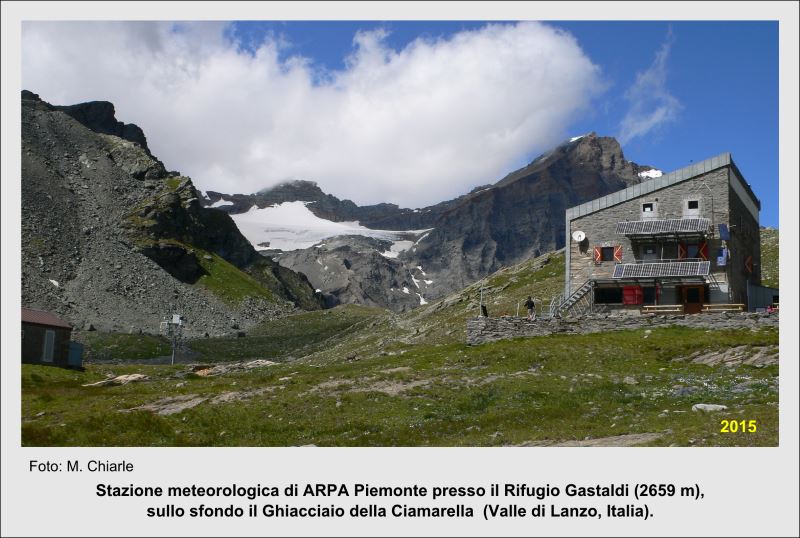
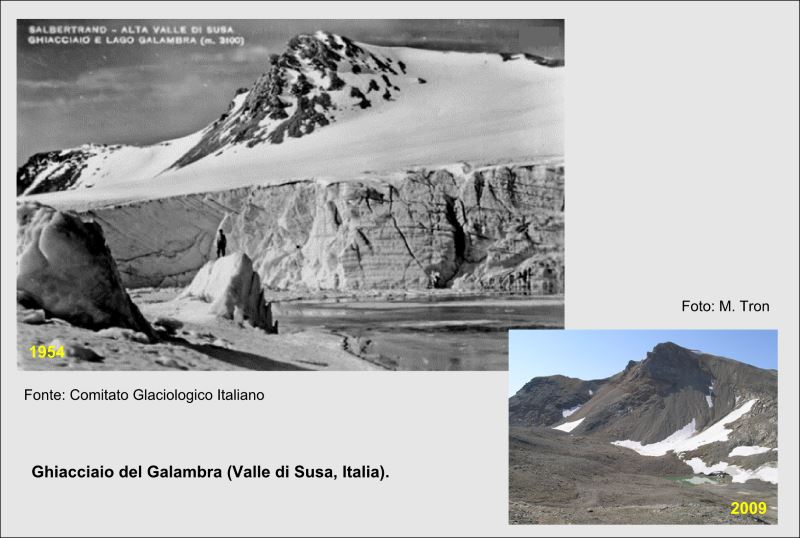
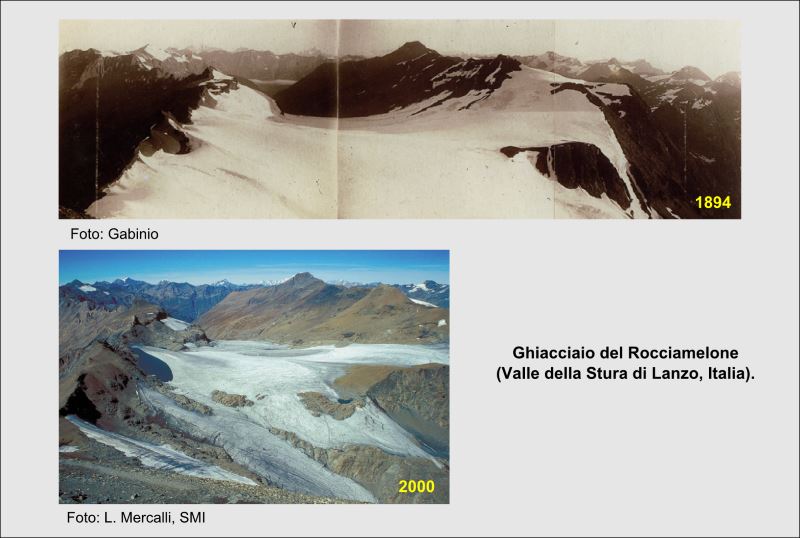
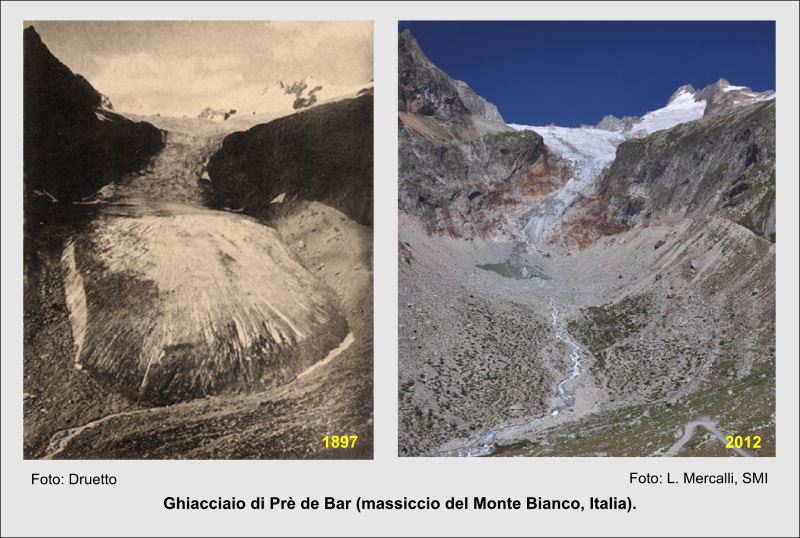
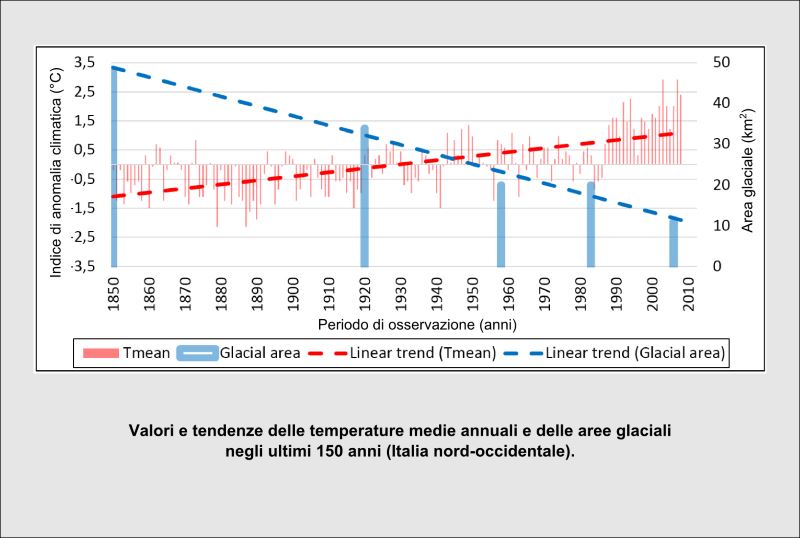
Between the late 19th and early 21st century, in the Alps the average air temperature has increased by about 2 °C, more than twice the increase in temperature in the northern hemisphere, of 0.8 °C. In the same period, precipitation showed a tendency towards an increase in the northern part of the Alps, and a tendency towards a decrease in the southern sector of the Alps.
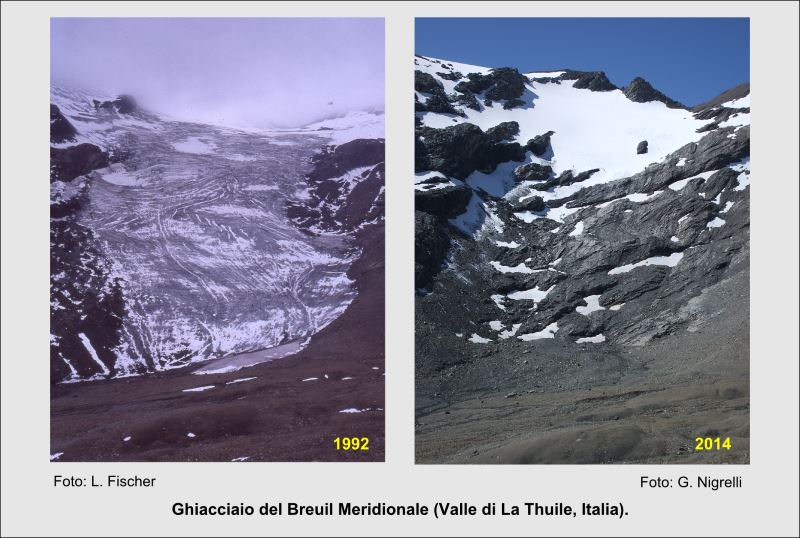
Since the end of the Little Ice Age (about 1850), glaciers in the Alps experienced a generalized retreat, interrupted by two short stages of advancement in the 20s and 70s of the last century. Overall, it is estimated that since 1850 glaciers in the Alps have reduced by about half. Beginning in the 80s of the last century, the rate of retreat has accelerated. The Italian glaciers are no exception and, given their geographical location, the retreating trend is more pronounced than for glaciers in the northern part of the Alps.
Climate change and the rising temperatures observed in many areas of the Earth are pushing scientists to identify and quantify the effects of the changes, and to construct realist future scenarios. High-altitude mountain environments (above 2500 m of elevation) have been shown to react very quickly to climate change, with clear and distinct signs. Given their sensitivity to climate change, glaciers are among the best terrestrial indicators of climate change.
In a study published in the journal Theoretical and Applied Climatology, we have compared daily temperature and precipitation measurements for eight climate stations from 1950 to 2012 with data on the areal extent, and the minimum and maximum elevation of 96 glaciers in Western Piedmont, in 1850, 1925-1934, 1957, 1983 and 2006. The analysis allowed us to relate the recent evolution of the glaciers to climate change documented by the climate stations, providing a clear picture of the significant retreat of the glaciers, and quantifying the relationship between glaciers and climate change.
Nigrelli G, Lucchesi S, Bertotto S, Fioraso G, Chiarle M. 2014. Climate variability and Alpine glaciers evolution in Northwestern Italy from the Little Ice Age to the 2010s. Theoretical and Applied Climatology. DOI:10.1007/s00704-014-1313-x.
Home » Focus » The strong retreat of the Italian glaciers